
WEAR LUXURY LAB GROWN DIAMOND JEWELLERY, YOUR ETERNAL LOVE’S SUSTAINABLE SPARKLE.
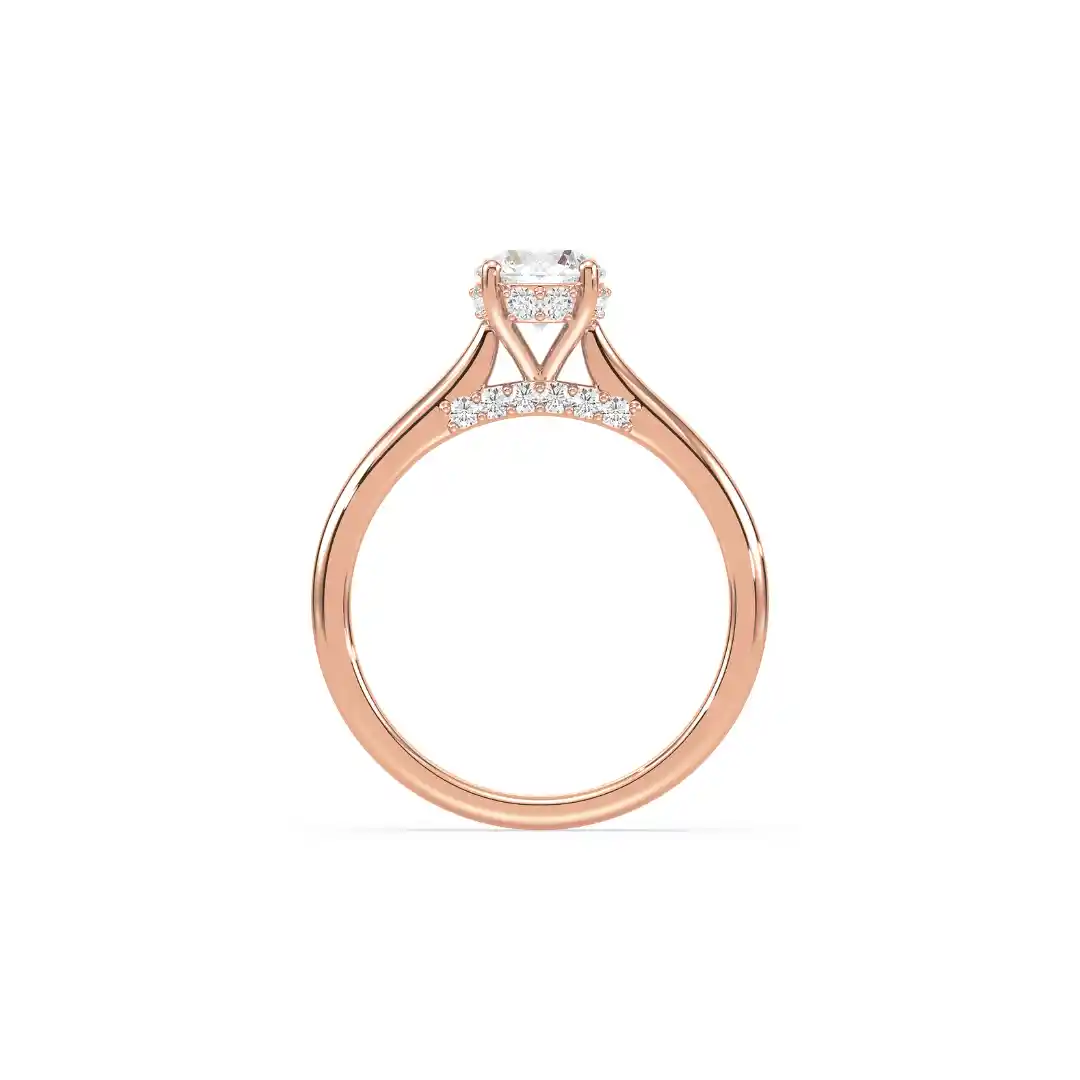
Ethical & Eco-Friendly Lab grown Diamonds
Many of our customers prefer lab grown diamond jewellery, as an ethical and budget-friendly choice. Often this means being able to afford a larger or higher quality stone, with customised colour options.
Financial reasons aside, there is an eco-friendly reason: Man-made diamonds don’t cost the earth.
Lab grown diamonds are as durable and brilliant as earth-made diamonds. Laboratory conditions harness renewable energy sources to cultivate crystals and offset the carbon footprint of diamond production. Controlled scientific processes mimic natural diamond formation with minimal environmental impact compared to traditional mining practices. Ethical engagement rings with a luxurious sparkle.
earth-made vs Lab Grown Diamonds
Natural Diamond Formation
Natural diamonds were formed within the Earth at 150 to 700 kilometres below the surface. Conditions of extremely high pressure and temperature produced pure crystallised carbon deposits in ‘diamond stability zones’ within the Earth’s fiery mantle. Diamonds are the hardest natural mineral, rated 10/10 on the Mohs Scale.
In rare geological events, deep-source volcanic eruptions of kimberlite magma delivered diamond deposits to the Earth’s crust. Access to naturally formed diamonds requires intensive mining processes. Extracted raw diamonds are cut and polished to unearth their true value. Each is a unique creation.
Laboratory Grown Diamond Process
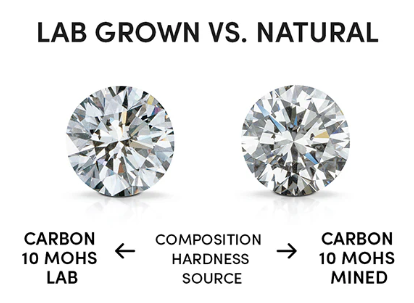
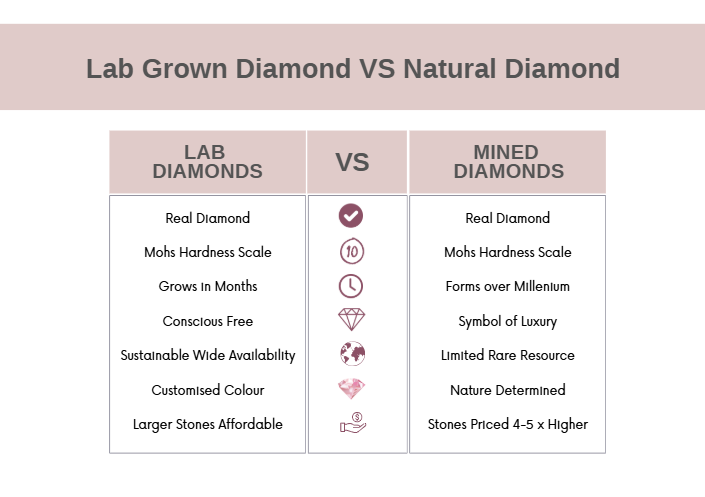
Laboratory Grown Diamonds are physically, visually, and chemically identical to their naturally formed counterparts. Both are real diamonds.
Lab grown diamonds are created from tiny carbon seeds of pre-existing diamonds. Scientists use advanced technology – either extreme pressure and heat or a special process known as chemical vapour deposition – to mimic the method of natural diamond formation. Over the course of six to ten weeks, a rough diamond is formed. The stone is then cut and polished in the exact same way as a mined diamond.
Man-Made Diamonds, Two Main Methods
There are two primary methods of producing man-made diamonds, and both use a small diamond seed to grow a large diamond crystal.
1. High Pressure High Temperature (HPHT)
This method mimics the conditions under which natural diamonds are formed inside the Earth. In controlled laboratory settings, a large machine is fed pure carbon material that is then crushed under 5-6 GigaPascals (GPa) of pressure and exposed to temperature extremes ranging from 1,300 to 1,600 degrees Celsius (°C). The carbon material dissolves, and carbon atoms deposit on the seed crystal to create a large diamond.
2. Chemical Vapor Deposition (CVD)
The CVD process involves placing a seed diamond in a small vacuum chamber filled with a heated mixture of hydrogen and carbon gasses. At temperatures of 700 to 1,200°C and 1-4 GPa of pressure, the gas molecules break down and layers of crystallised carbon form around the seed, growing a more substantial diamond.

Lab Grown Diamond Certificates
All our lab grown diamonds are supplied with an individual laboratory certificate which are separate to the Valuation Certificate we will give you for your Insurance Company. The Laboratory Certificates are independent grading certificates which show the cut, colour, clarity, weight and serial number of the diamond.
Should you purchase a sought-after GIA Laboratory graded diamond, your diamond will also have its unique serial number inscribed on it which is only visible under fluorescent light.
